Business chatbot · Small businesses of 5 to 50 employees
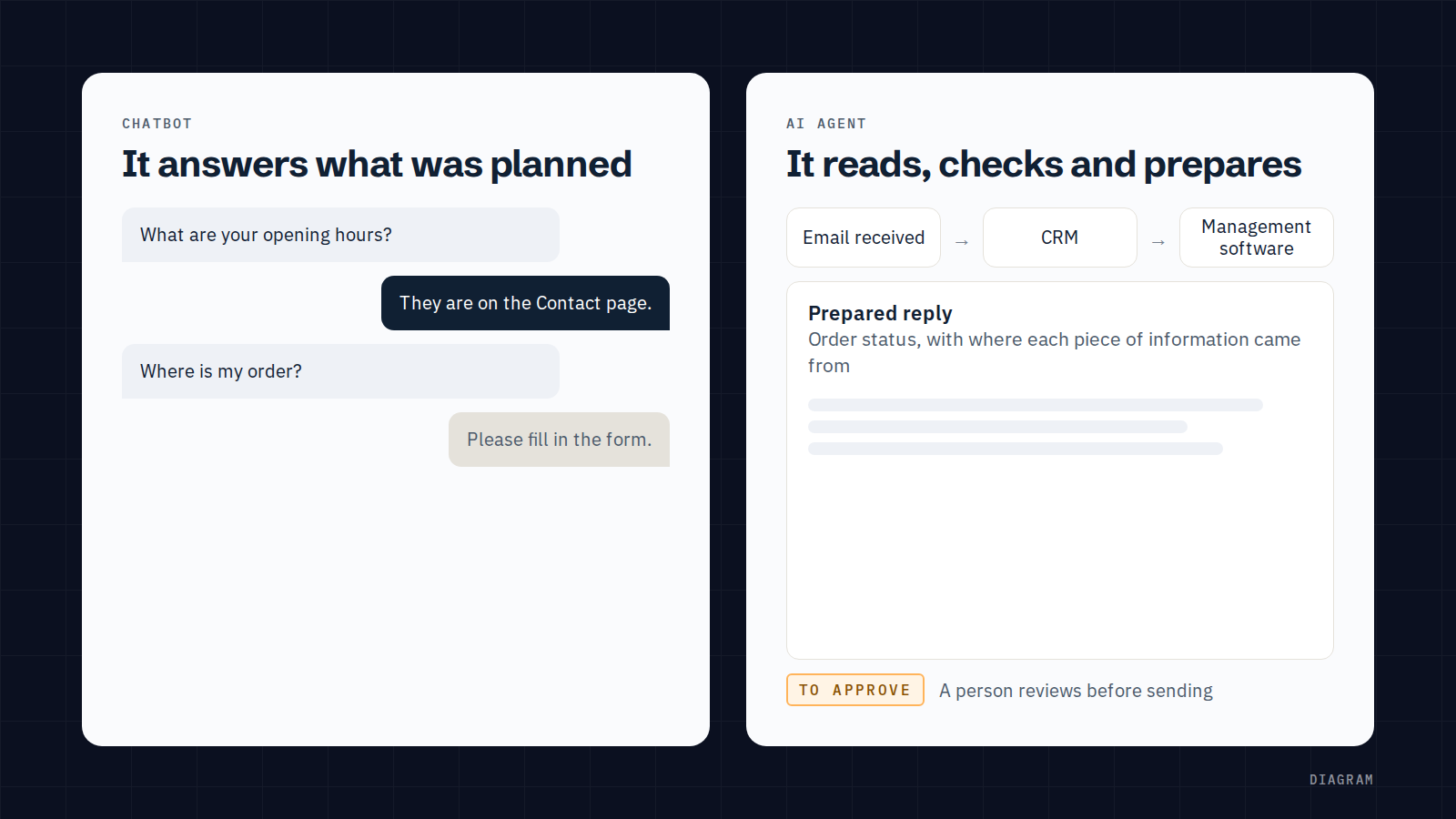
A chatbot answers the questions you planned for. An AI agent reads the request, looks up the information in your tools and prepares the reply or the action, which a person approves whenever it commits the business. For a small business the right choice depends on the task, not on the technology: if your customers mostly ask the same ten questions, a chatbot is enough, and we will tell you so. Équipage IA looks at the task, gives you a written opinion, then sets up what was decided inside the tools you already use.
Twenty to thirty minutes. No commitment.
A chatbot converses; an agent works. The first answers in a chat window, from scripts or documents it was given. The second is connected to your tools (mailbox, CRM, management software): it finds the customer, reads the history, prepares the reply or the document, and flags what it cannot handle.
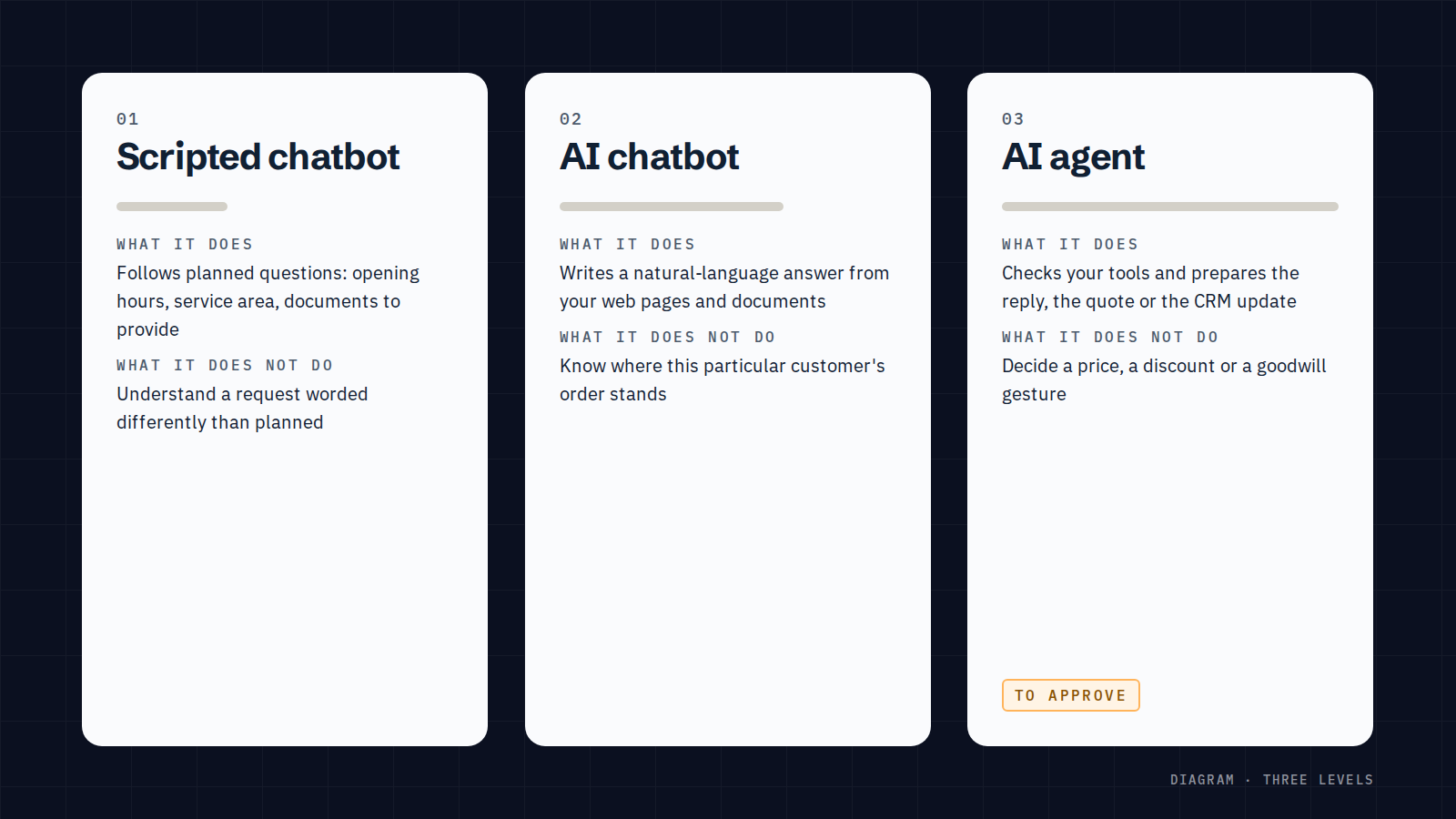
There are degrees in between, and vendors blur them. Three levels are fairly distinct.
| Level | What it does | What it does not do |
|---|---|---|
| Scripted chatbot | Follows a tree of planned questions: opening hours, service area, documents to provide, pointing to the right form | Understand a request worded differently than planned, or look anything up in your tools |
| AI chatbot | Writes a natural-language answer from your web pages and documents | Know where this particular customer's order stands, or change anything on your side |
| AI agent | Reads the request, recognises the customer, checks your tools, prepares the reply, the quote or the CRM update, and says where each piece of information came from | Decide a price, a discount, a goodwill gesture or the answer to a complaint for you |
The same distinction, seen from the service side, is covered in our article on what an AI agent actually does in a business, and what it does not.
When the answer already exists in writing and does not depend on who is asking. Opening hours, service areas, documents needed for a file, how to file a complaint: a scripted chatbot, or a well-kept FAQ page, handles these without connecting to any of your tools.
It is the cheapest case to set up and the most predictable, and it is often the right starting point. The limit shows quickly, though: as soon as a customer asks "where is my order?" or "can you redo the quote with the other reference?", the chatbot can only point to a form or a phone number. The customer made the effort to write and has to start again somewhere else. If those requests are frequent in your business, the chatbot moves the work instead of removing it.
When answering means fetching information specific to the customer, from a tool the chatbot cannot see, and someone currently spends time doing it. Three signs tell you.
One point comparisons tend to skip: an agent does not replace a fixed rule when a rule is enough. An acknowledgement of receipt, a sort by keyword, a reply template in your mailbox all work without any AI, more simply and at lower cost. An agent earns its place when something has to be read, retrieved and written.
It can get things wrong, and what it writes commits your business. A chatbot that announces a delivery date you cannot meet, an availability that is not accurate or a discount nobody approved creates a dispute, not a time saving.
Three rules are set before go-live, whatever tool you choose.
When the system talks directly to your customers, they also need to be told they are speaking to an AI: that is a transparency obligation under the European Union's AI Act, detailed in our article on answering customer requests with an AI agent (this is not legal advice). The easiest mode to control is the one where the agent prepares and a person sends: the reply then goes out in the name of someone who has read it.
By looking at your real requests, not a brochure. Take the last fifty customer requests you received, from every channel, and sort each into one of three boxes.
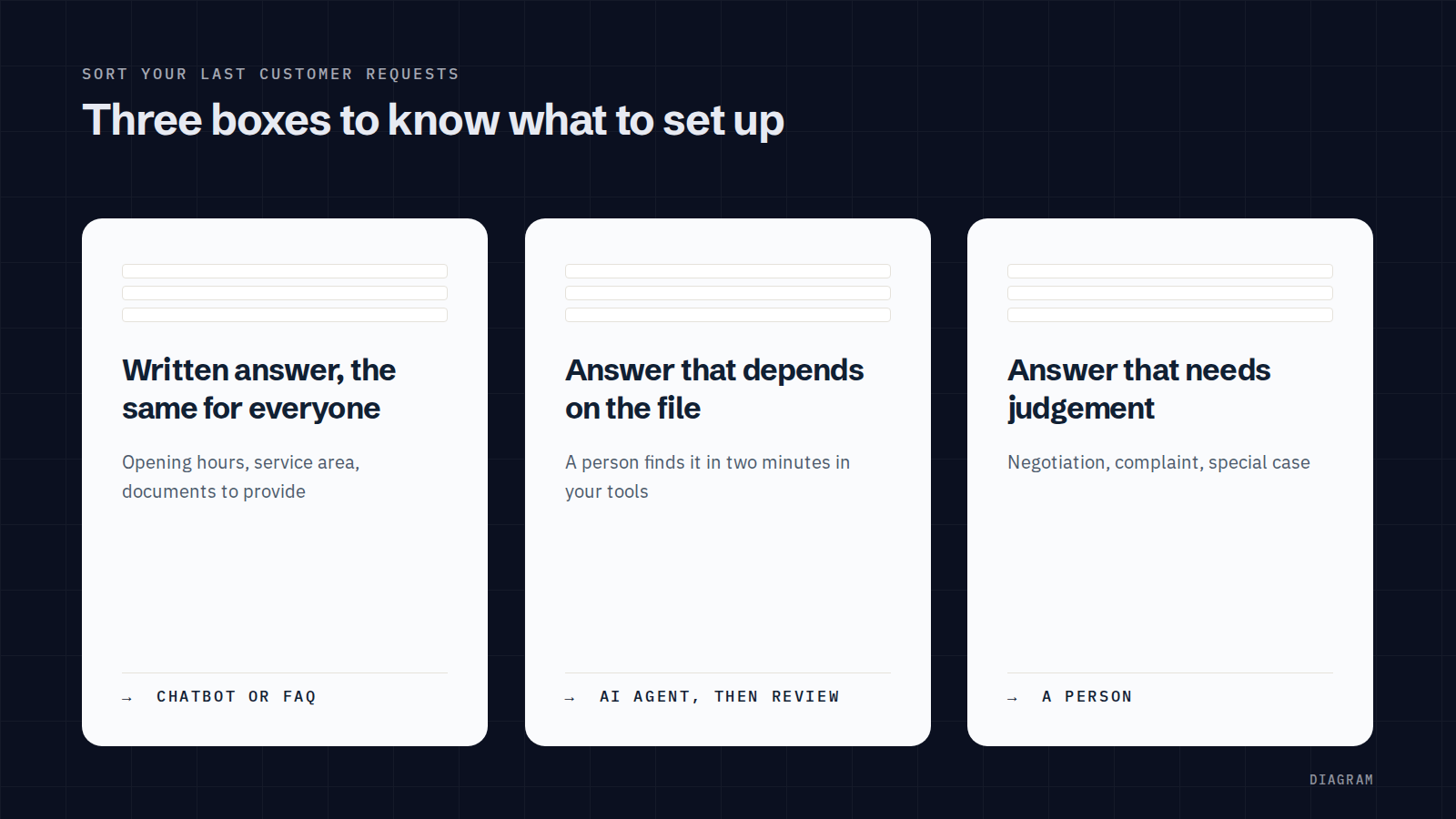
The split between the three boxes tells you where to look. If the first dominates, start with a chatbot or an FAQ page. If the second weighs most, it is the agent. If the third dominates, no tool will save you much, and it is better to know before spending anything. This count is part of what we look at with you, on one task, during the discovery audit.
Through a discovery audit on a single task, then a written scope before any paid work. The first system is built inside your existing tools, with no extra tab to open, and it runs in trial for two weeks before go-live.
To see how we choose the first task to give an agent, and the ones better left alone, read AI agents for small businesses: where to start, and when to skip them.
| The question | Our answer |
|---|---|
| Who for | Small and mid-sized businesses of 5 to 50 employees that receive customer requests by email, web form or phone, and whose handling falls on people who are already busy: trade and distribution, industrial subcontracting, business services, installation. No sector is excluded on principle. |
| What | An opinion on the task, then setting up the chosen system in your existing tools, with documentation and hands-on training. |
| Where | Remote, head office in Paris, on-site meetings possible in the Île-de-France region. |
| What we do not take on | Projects that expect an automatic reply to every request without review, systems that negotiate or set a price alone, and requests for a guaranteed result. |
It is enough if your customers mostly ask questions whose answer is written down and the same for everyone: opening hours, service area, documents to provide. It stops being enough when customers write by email, ask about the state of their file or want a quote changed: the chatbot sees neither your mailbox nor your management software, and sends the customer to a form.
ChatGPT is a general-purpose assistant: it answers from what it learned, and knows nothing about your business unless you give it something. A business chatbot answers from your pages and documents, within the frame you set. An agent goes further: it is connected to your tools and prepares a specific piece of work, which you approve.
Yes, as soon as they interact directly with it: the European Union's AI Act requires it, unless it is obvious from the context. If the agent prepares and a person sends, the reply goes out in that person's name. This answer is not legal advice, and you should ask for it for your own situation.
It can acknowledge the request, ask the missing questions and pass the file on. Pricing alone is another matter: a price or a discount commits the business, and we always have a person approve it before it goes out. Our requests and quotes page describes how this works.
The system is hosted with you or on a European server, and the models used and what is sent to them are written into the scope before the build. You enter your own access credentials: they are encrypted, never displayed, never seen by us, and revoked at the end of the contract. Your data can be exported in open formats at any time.
The trial period lasts two weeks and is designed for that: the system prepares without sending anything, and you compare its proposals with what your team answered over the same period. You judge on evidence before any go-live. We promise no result figure, before or after.