AI agents · Paris

AI Agency in Paris for Small Service Businesses

Équipage IA is an AI agent agency with its head office in Paris, at 47 rue Vivienne. We set up one agent on one specific task (incoming requests, proposals, follow-ups, written prospecting) inside the tools your business already uses. The agent prepares the work; a person on your side approves anything that goes to a client. We work with businesses of five to fifty people, and every engagement starts with a twenty to thirty minute discovery audit on a real task.

Twenty to thirty minutes. No commitment.

What kind of AI agency are we, and what are we not?

We build working agents for day-to-day operations. We are not a creative studio. Search for an AI agency in Paris in English and much of the first page is generative image and film studios working for luxury and fashion brands. That is a different trade. We do not produce campaigns, visuals or videos for clients; we connect an agent to your mailbox, your CRM or your management software so that a recurring written task gets prepared on time.

Small Paris office of a service firm: an employee reviews on screen a reply prepared from a client request received by email.

Most businesses in Paris that need this are small service firms. INSEE, the French statistics office, counts 514,455 economically active legal units in Paris in 2024, and more than a third of them (35.5%) are in professional, scientific, technical and business support services: consultancies, architecture and engineering practices, agencies, design offices. At the end of 2024, 72% of the 188,002 business establishments in Paris employed one to nine people (INSEE, Paris departmental file, published August 2026). In a team that size, nobody's job is to answer incoming requests. A partner or a project manager does it between meetings, and a request that waits from Thursday evening to Monday has often gone elsewhere.
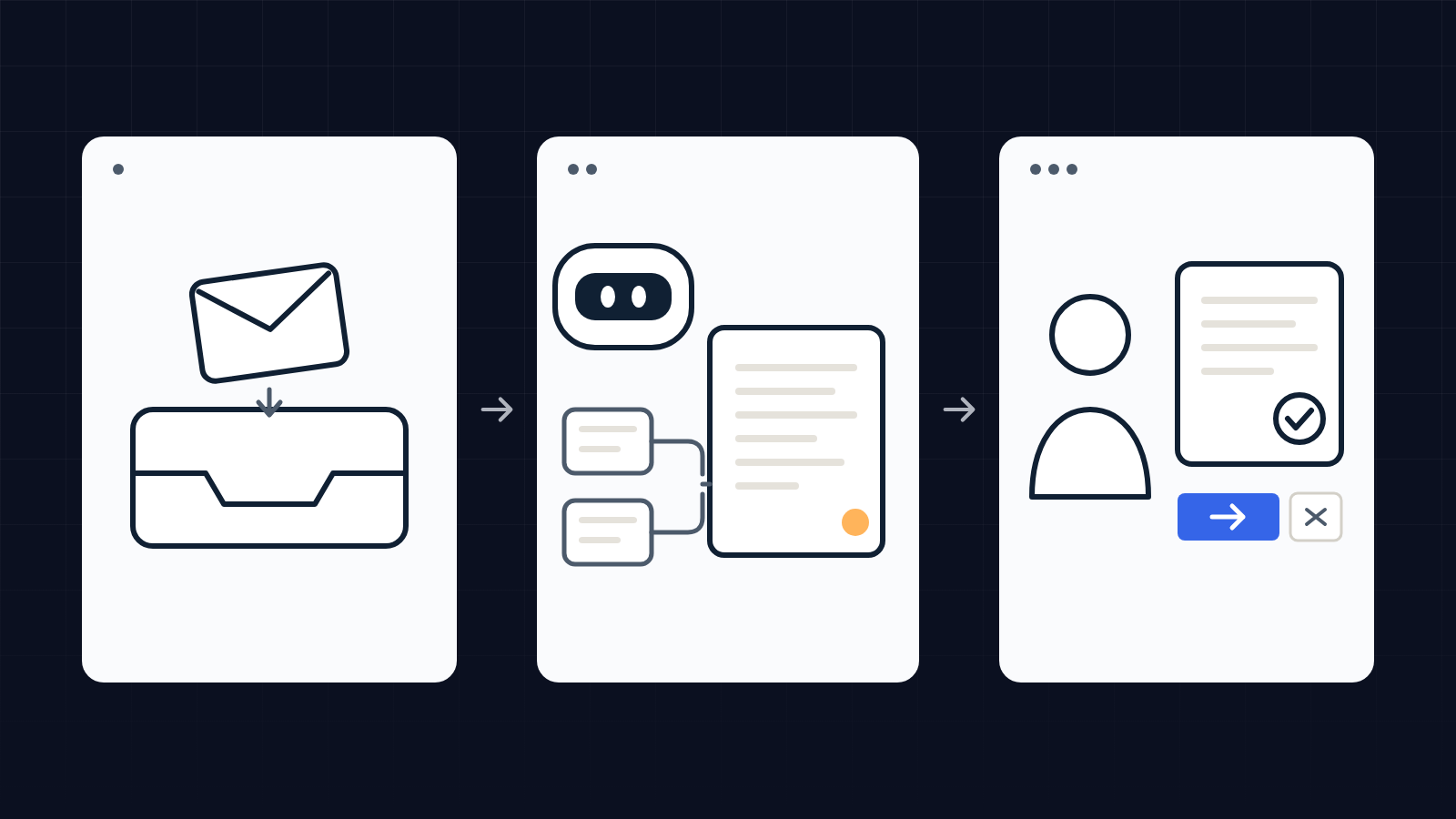

Which task should a small service business hand to an agent first?

The one that arrives in writing, comes back every week, and can be checked in a few seconds. In a Paris service firm it is almost always one of these three.

Three-step diagram: a request arrives by email, the agent prepares the reply with its sources, a person reviews it and decides whether to send.
  • Incoming requests. Website form, email, forwarded message: the agent reads the request, recognises the client if they already exist, gathers your past exchanges and prepares a reply or a proposal with its sources. See the requests and quotes agent.
  • Proposals that got no answer. A proposal sent three weeks ago and never followed up is the easiest one to lose. The agent prepares the planned follow-ups and stops at the first reply. See quote follow-up without losing your Fridays.
  • Written prospecting. The agent applies your criteria, identifies the right contact, drafts a message based on something verifiable and keeps your CRM up to date. See the prospecting agent.

In all three cases nothing leaves without a person opening it first. Anything that commits the business (a price, a discount, a deadline, the answer to an unhappy client) stays a human decision, and that line is written down before anything is built.

How do you compare AI agencies in Paris?

Ask them what their pages leave out. On 8 October 2026 we recorded Google's first page for "agence ia paris", the French search a Paris business owner would type: eight agency pages and two agency directories. We could read the text of seven of the eight agency pages (the eighth showed only a cookie consent window). Six of them also sell AI training for your staff. None of the seven says what the agency refuses to automate.

Small business owner comparing two agency proposals on a desk, with a checklist of questions beside them, in a Paris office.

This is no criticism: a sales page describes what you do. But if you are about to give someone access to your mailbox and your CRM, what the system will never do matters just as much. These are the five questions we suggest you put to any agency, including us.

The questionWhat a good answer containsOur answer
What do you refuse to automate?A precise list, not "it depends"Making up a price when the data is missing, bulk sending, cold outreach to private individuals, follow-ups after someone has opted out, working around software that offers no official access
Who approves what?Where the agent stops and a person takes over, written before the buildThe agent prepares; a person approves anything that commits the business to a client, a supplier or an employee
Who sees our credentials and data?Where it is hosted, who enters the credentials, what happens at the end of the contractHosted on your side or on a European server; credentials entered by you, encrypted, never visible to us, revoked when the contract ends
How will we know it works?A test period on your real files before go-liveTwo weeks of trial running: the agent works without sending anything, and its drafts are compared with what your team actually sent
Who will we deal with?A name, and a promise it will not change mid-projectHakim Ouahabi, from the first meeting to go-live

Before granting any access, the security questions are covered in four questions to ask before connecting an AI agent to your tools.

How does an engagement work?

It starts at your office or on a video call, with a real task, and ends with a go-live decision that you make. A first system for one role is delivered in two to three weeks, trial period included.

  • Discovery audit: one task, your tools, the decisions that must stay human. You leave with a written opinion, even if it says there is nothing to build.
  • Written scope: what the agent does alone, what goes through you, the sources it may use, and a fixed-price quote you approve before any paid work.
  • Build: read-only connection to your tools first, rules, output template, tests on your past files.
  • Trial period, two weeks: the agent works without sending anything, and we adjust it with the person who uses it.
  • Ongoing support: monthly supervision and adjustments, no lock-in, one month's notice.

For a business elsewhere in the Paris region, the approach is the same: see AI agent agency in Île-de-France. The full framework is on the offers page.

Who, what, where, and on what terms?

The questionOur answer
Who forSmall businesses in Paris, typically 5 to 50 people, where part of the work arrives in writing: consultancies, architecture and engineering practices, agencies, design offices, business services, trade and distribution. No sector is excluded in principle.
WhatDesign and set-up of AI agents and automations inside your existing tools, one task at a time, with documentation and hand-over.
WhereHead office at 47 rue Vivienne, 75002 Paris. Meetings at your office anywhere in Paris; travel within the region is not charged for the discovery audit and the trial period. Rest of France remotely.
TermsDiscovery audit before any quote. Scope and price written before work starts. Human approval on anything that commits the business. Monthly support with no lock-in, one month's notice. European hosting, credentials entered by you and never visible to us, data exportable in open formats.
What we do not take onProjects that want to automate everything at once, anyone expecting a guaranteed number of meetings or sales, general AI training, creative or advertising production, and requests that would mean working around a platform's terms.

FAQ

Are you based in Paris?

Our registered head office is in Paris, at 47 rue Vivienne in the 2nd arrondissement. The founder works day to day from the Val-d'Oise, just north of Paris, and we come to your office for the two moments where being there matters: understanding the task at the desk where it is done, and correcting the agent during the trial period.

Do you come to our office, and is travel charged?

Yes, anywhere in Paris, and travel is not charged for the discovery audit or the two-week trial period. Beyond that, travel terms are written into the scope before any paid work.

We are a team of eight. Is that too small?

No, if a written task comes back often enough to take up a regular part of someone's time. What matters is repetition, not headcount. A few requests a month do not justify an agent, and we will tell you during the audit rather than after the quote.

Do you make AI images or videos for brands?

No. Many agencies that come up for this search do, and they serve that need well. We build agents that prepare everyday written work inside your tools.

Do you offer AI training?

No. Most of the Paris agencies we read do; it is not our trade. Hand-over of the system we deliver is included, with its documentation. For general AI training for your staff, a training provider is the right choice.

Do we need to change our software?

No. The agent works inside the tools your team already uses: mailbox, CRM, management or invoicing software. If one of them offers no official access, we tell you during the audit rather than work around it.