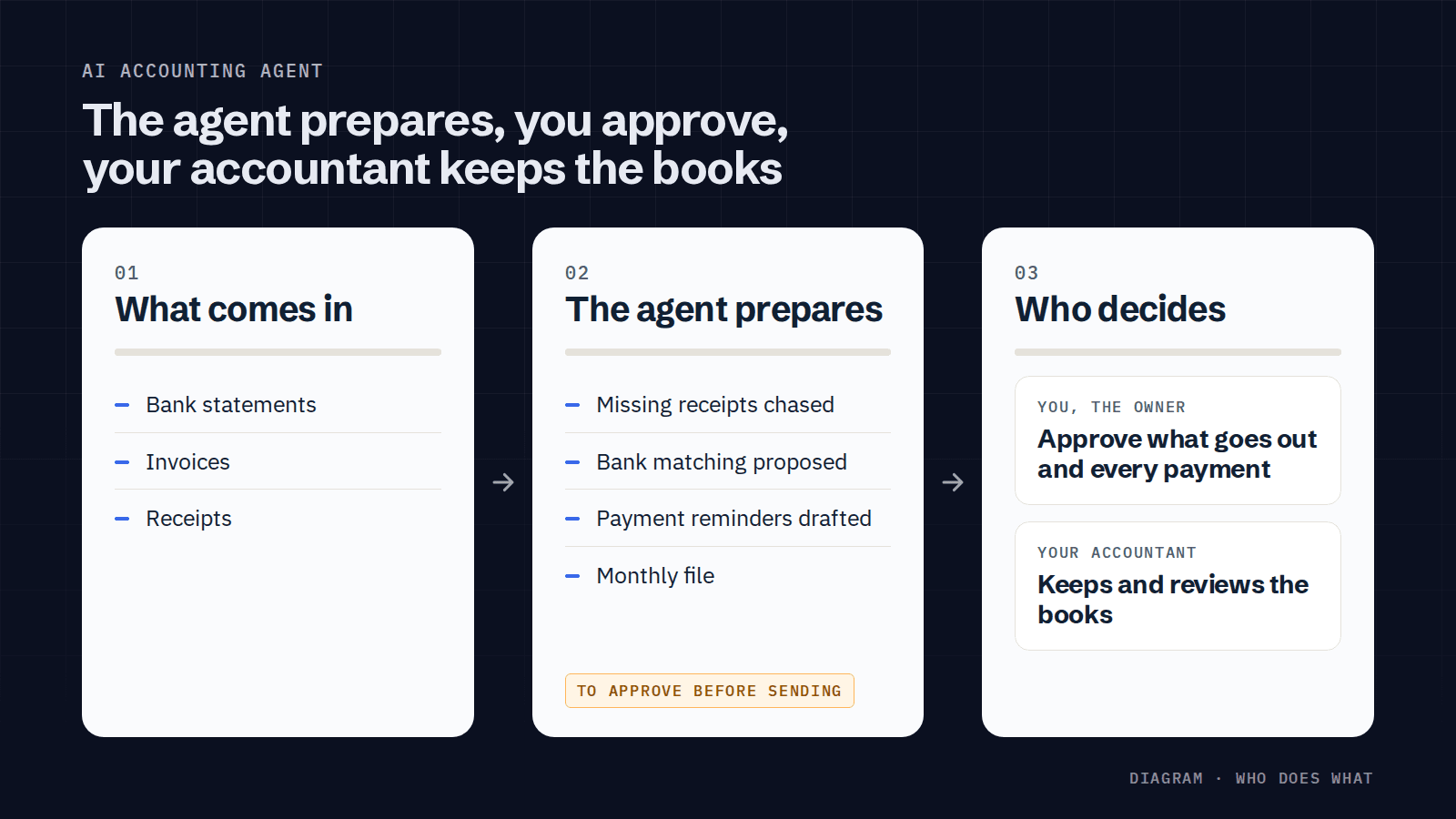
What is an AI accounting agent?
It is software that works inside your tools (email, bank feed, invoicing software, accounting software) and chains tasks together according to rules written with you. Accounting software waits for someone to feed it documents; an agent goes and gets them, compares them, prepares the next step and flags what needs a decision. In practice, it reads a supplier invoice that arrived by email, links it to the right payment, notices that a bank line has no receipt, drafts the request to the supplier and puts it in your approval queue.
The difference with a chat assistant is access to tools: an assistant answers a question, an agent works without being opened, within the limits you set. We describe those limits in our article on what an AI agent actually does in a business.
What you can hand over
Missing receipts. This is often what delays the monthly close: a bank line with no invoice, an expense receipt nobody sent in. The agent spots the gap, identifies the likely sender and drafts the request. You decide whether it goes out.
Proposed bank matching. The agent pairs each bank line with an invoice and flags partial payments, duplicates and amount mismatches. It proposes; whoever keeps your books accepts or corrects.
Payment reminders. The agent tracks due dates, drafts a reminder that fits the customer's history and shows it to you. A customer in dispute or a key account is not chased like the others: that call is yours.
The monthly file for your accountant. Documents filed, anomalies listed, open questions written up. Your accountant receives a complete file instead of a box of paperwork.
Structured e-invoices. As more countries require invoices in a structured format, less data needs to be keyed in. Checking still has to happen: does the invoice match what was ordered and delivered? That is where an agent that cross-checks several sources earns its place.
This is the scope of our accounting agent.
What stays with you and your accountant
| Task | What the agent prepares | Who decides |
|---|---|---|
| Missing receipts | Spots the gap, drafts the request | You, before it is sent |
| Bank matching | Proposes matches, flags duplicates and mismatches | Whoever keeps your books |
| Payment reminders | Tracks due dates, drafts the reminder | You, especially for a sensitive customer |
| Coding and journal entries | May suggest an account | Your in-house bookkeeper or your accountant |
| Review, year-end accounts, tax return | Gathers the documents requested | Your accountant |
| Paying a supplier | Prepares the payment, checks the invoice | You, always |
There are two reasons for this split. The first is practical: a coding error or a payment sent to the wrong supplier costs more than the time saved. The second is legal.
Who is allowed to keep your books?
In some countries, keeping, reviewing or closing the accounts of a business you are not employed by is reserved for a regulated profession. France is a clear example: a 1945 ordinance reserves this work for chartered accountants registered with their professional body, and on 21 January 2026 the criminal chamber of France's highest court confirmed that it can only be done habitually by a registered accountant, or by an employee for their own employer.
For a business owner, the takeaway travels well. Your own team can use an agent on your own accounts, the way it uses software. An outside provider that "keeps your books" with an agent and no qualified accountant behind it may expose you to risk, depending on where you operate. Before you sign, ask who keeps the books, who reviews them and who is answerable for them. We are not lawyers: ask your accountant as well. They are the one who will receive the work the agent prepares.
What pages on this topic tend to leave out
Method: on 6 October 2026, we read in full five French-language pages from agencies and software vendors presenting an AI accounting agent, found in web search results for the French query. We also read the English-language pages from QuickBooks, Zeni and ibl.ai that appear for this topic.
Of the five French pages, three quote a time saving without publishing how it was measured (volume, period, type of documents). One quotes a customer's estimate. Only one declines to give a percentage and explains how to measure it in your own business. Two write that the agent handles routine cases with no human involvement. None mentions who is legally allowed to keep the books.
Our view: a time-saving figure that does not say what was measured, or how, tells you nothing about your business. What you can measure yourself, before and after: time spent per document, the share of documents that reach your accountant without correction, and the delay between an anomaly being spotted and being resolved.
Are the models reliable enough for this work?
On well-defined tasks, yes, and they are improving fast. On 1 October 2026, the US company Mercor published a study in which twelve licensed CPAs (about five and a half years of experience on average) worked through four month-end close scenarios: find the right figures in a company's files, do the math, deliver a table. The accountants scored about 37% on average; the latest models achieved a perfect score, at a cost per scoring criterion more than ten times lower. Eighteen months earlier, the best model still scored below the accountants' average.
The authors set out the limits themselves: twelve participants, tasks that test what AI does best (following detailed instructions, searching through files), and not the whole job, which includes client relationships and everything that is never written down. Mercor also sells model evaluations. What the study tells an owner: preparation can be handed over, provided someone reviews it. It does not say your accountant becomes unnecessary.
Where to start
Pick one flow, the one that overflows: usually missing receipts or payment reminders. Write down what the agent may do on its own (file, match, prepare) and what goes through you (anything sent to a customer or supplier, any payment). Show that split to your accountant before you start: they will tell you how they want to receive the work. Review everything for the first month, then decide what can skip review. The questions to ask about access and data are in our article on four questions to ask before connecting an AI agent to your tools.
FAQ
Can an AI agent replace my accountant?
No. It prepares the work upstream: documents, proposed matches, reminders, the monthly file. Keeping and reviewing a company's accounts for a third party is a regulated activity in several countries, and responsibility for the accounts stays with your accountant and with you.
Can the agent pay my suppliers?
It can prepare the payment and check that the invoice matches the order. The payment itself should stay a human decision: it is the hardest action to undo when something goes wrong.
Do structured e-invoices make the agent unnecessary?
They remove part of the data entry, since the invoice arrives with structured data. They do not check that the invoice matches what was ordered and delivered, chase a late payer or request a missing receipt.
Do I need to change my accounting software?
Usually not: the agent works with the tools you already have, through their connections or exports. What to check during the discovery audit is what your software already does on its own. If it already matches invoices to payments, the agent will mostly help with reminders and missing receipts.
For an overview of what we automate in a small business, see our custom automation page.
Sources: French ordinance no. 45-2138 of 19 September 1945, articles 2 and 20 (text published by the French Ministry of Higher Education, accessed 6 October 2026) · French Court of Cassation, criminal chamber, 21 January 2026, no. 24-81.008, summarised by Eurojuris (accessed 6 October 2026) · Mercor, "Human Baselines for Benchmarks: AI Now Outperforms Junior Accountants", 1 October 2026 (mercor.com, accessed 6 October 2026) · Review of five French-language pages and three English-language pages on AI accounting agents, 6 October 2026. No customer is named; no results figure is claimed.