What does an AI sales agent do?
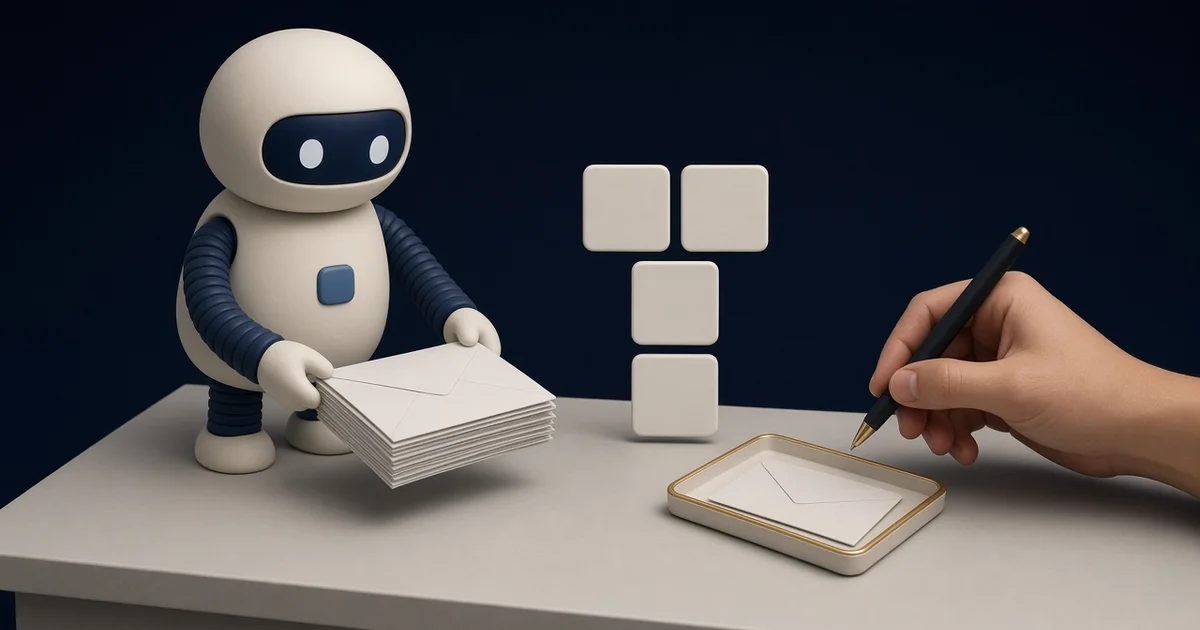
An AI sales agent is software that takes over the repetitive steps of selling, inside your tools and under written rules: building a list of companies that meet your criteria, dropping those that do not, finding a contact and a work email address, reading the company's website to pick out one specific fact, drafting a message that starts from that fact, scheduling follow-ups, and logging every exchange in the CRM. It works every day on a small number of prospects, where a salesperson tends to prospect in bursts. It stops where you decided it stops: it does not choose the target, it does not answer a prospect who asks a question, and it does not set a price.
What separates it from a writing assistant is access to your tools. An assistant drafts an email when you ask for one. An agent goes and gets the information, prepares the message, puts it in the right place and follows up on the planned date.
Why most definitions lead with autonomy
Many of the pages on the subject are published by companies selling sales software. They describe the agent as acting on its own, with little or no human input, and they are written for sales teams with SDRs, quotas and managers. None of the pages we read publishes a count of what an agent did in service, with its method and its sample: how many companies it looked at, how many it dropped, and why.
In a company of twenty people, the question is a different one. The owner is often the only salesperson, and every email goes out under their name. What they need to know is what they can hand over safely and what has to stay with them. That is the split we make here, task by task.
What an AI sales agent prepares
It sorts before it writes. The agent applies your criteria (industry, size, region, buying signals) and drops whatever does not fit, noting why. It is the least visible task and the most useful one: an email sent to a company outside your target wastes everyone's time and damages the reputation of your sending address.
It looks for one verifiable fact. Before drafting, the agent reads the company's website and picks out one precise sentence about what it does. The message starts from that observation, not from a line that could go to anyone. If nothing on the site connects the company to your offer, the file does not go out.
It drafts the first email and the follow-ups. The wording follows templates you approved. The agent does not invent arguments; it inserts the observation specific to each company and one sentence linking it to your offer.
It follows up on schedule. Four to five days after the first email, then one last time. It stops as soon as someone replies or asks not to be contacted again.
It keeps the CRM current and hands over. Every email, every date, every reply is logged. When a prospect answers, the context is ready: who they are, why they were contacted, what was said. That is how our AI prospecting agent works.
What the salesperson keeps
The target. The agent applies criteria; it does not decide who deserves to be contacted. In our case, a first batch of 38 companies was reviewed and approved by hand by the owner, to set the criteria before the agent took over.
The wording that goes out under their name. The templates for the first email and the two follow-ups are approved once, in writing. Anything outside that frame goes back for individual approval.
The replies. A prospect who replies asks a question, raises an objection or suggests a time. That is where the sales relationship starts, and it belongs to a person. The automated sequence stops at the first reply.
The price, the negotiation and the decision to stop. The agent can prepare a brief before a meeting or gather what a quote needs. It sets no discount and no deadline. For the quoting side, see our page on enquiry and quote agents.
| Step | What the agent prepares | What the salesperson keeps |
|---|---|---|
| Targeting | Apply the criteria, drop with a written reason | Write the criteria, approve the first list |
| Research | Find the contact, pick out one fact from the website | Decide when the link to the offer is doubtful |
| First email | Insert the observation into an approved template | Approve the template, approve each exception |
| Follow-ups | Keep to the schedule, stop at the first reply | Decide how many follow-ups and in what tone |
| Prospect's reply | Prepare the context of the exchange | Answer, offer the meeting, negotiate |
What our own sales agent shows, in figures
We prospect with a sales agent ourselves, in a single sector: wholesale distribution and industrial subcontracting companies in France. Here is what it did in its first thirteen days.
Method: count taken on 1 October 2026, read-only, from our agent's two logs (the record of companies reviewed and the sending queue). Period: 19 September to 1 October 2026. Sample: 182 companies reviewed, 25 files prepared. No personal data is published.
80% of companies dropped before any email. Of 182 companies reviewed, 146 were dropped. The reasons: 69 had no usable work email address, 41 had a website that could not be found or read, 17 showed no sign of quoting or a product catalogue, 10 had a website based outside France, 6 were outside the target or the area, and 3 were in insolvency proceedings.
36 companies kept. 25 produced a complete file in our CRM, 10 were added to a second sending campaign, and 1 was still being qualified. Each CRM file holds a first email and two follow-ups, built from an exact quote taken from the company's website. Of those 25 files, 24 first emails went out between 23 September and 1 October, followed by 12 first follow-ups four to five days later. One file was stopped before anything was sent. No more than 7 emails ever went out on a single day.
What the agent found at prospects. Of the 25 personalisation notes the agent wrote, 21 suggested an opening on handling enquiries and quotes, 3 on internal tasks, and only 1 on prospecting. That figure has a known bias: our agent drops precisely the companies that show neither quoting nor a catalogue (17 dropped for that reason). It holds for our target only: among wholesale and industrial subcontracting companies that show quoting or a catalogue, 21 openings out of 25 concern enquiries and quotes.
What stayed human. The starting batch of 38 companies, approved by hand. The templates for the three emails, approved once in writing on 23 September: any wording outside those templates would need individual approval. And every reply.
What we are not publishing yet. The reply rate: no final follow-up has gone out yet, and a rate calculated before the sequence ends would be wrong. Time saved: it has not been measured. We will update this article when both figures exist.
When a sales agent is the wrong answer
If the enquiries already reaching you wait several days for an answer, prospecting harder is filling a leaking bucket. Start with incoming enquiries and with following up the quotes you have already sent: those are customers who chose you once already.
Two other situations do not suit it. A target you cannot put into words: the agent will only reproduce the vagueness, faster. And a market of a few dozen accounts you all know by name: a spreadsheet and an hour a week will do, and AI adds nothing.
Where to start
Write your target in five lines: industry, size, region, the signal that shows a company needs you, and the reason you would drop one. Then write the first email exactly as you would send it yourself. Have the agent prepare twenty files, read every one of them, and only then decide what can go out without review. That is the method we apply to our own prospecting, and we set it out in more detail in our article on what AI agents actually do for a small business.
FAQ
Will an AI sales agent replace a salesperson?
No. It takes away the preparation: research, sorting, drafting from a template, follow-ups and data entry. The relationship, the answer to an objection, the meeting and the negotiation stay with a person. In a small company, what it mainly changes is that the owner prospects every week instead of when time allows.
Can it send emails without me reading them?
Only inside a frame you have approved in writing: templates signed off once, a personalised part checked before each send, capped volumes. Anything outside that frame comes back to you. At the start, read everything.
Is it legal to cold email businesses with an AI agent?
In the United States, the CAN-SPAM Act makes no exception for business-to-business email: headers must be accurate, the subject line must not mislead, the message must say it is an advertisement, give a valid postal address and a clear way to opt out, and opt-outs must be honoured within 10 business days (FTC compliance guide). In the UK, the consent rule for marketing emails does not apply to companies, but you must not hide who you are and must give a valid address to opt out; sole traders and some partnerships are treated as individuals, and UK GDPR applies as soon as you hold a named person's details (ICO guidance, under review following the Data (Use and Access) Act). An agent changes none of this: the sender stays responsible.
What is the difference between an AI sales agent and an AI SDR?
An AI SDR is a sales agent sold to replace or extend a sales development team: research, outreach, follow-ups, booking meetings. The tasks are the same. What differs is the setting: the term assumes a team with SDRs and managers. In a company of twenty, the owner is the SDR, so the useful question is not how many seats the agent replaces but which steps it prepares and which ones stay with you.
Sources: Équipage IA internal count of 1 October 2026 (logs of our prospecting agent, period 19 September to 1 October 2026, 182 companies reviewed, 25 files) · "CAN-SPAM Act: A Compliance Guide for Business", Federal Trade Commission, August 2023, edited January 2024, consulted 1 October 2026 (ftc.gov) · "Business-to-business marketing", Information Commissioner's Office, consulted 1 October 2026 (ico.org.uk). No prospect and no customer is named; no sales result figure is claimed.