AI agents · Logistics and transport · Seine-et-Marne

AI for logistics and transport companies in Seine-et-Marne: quotes, tracking replies and damage claims prepared at the office, you approve

In a transport or logistics SME in Seine-et-Marne, an AI agent first pays off at the office: quote requests by email, tracking questions, damage files with their deadline, matching subcontractor invoices. It reads your tools, prepares, and a person approves.

Twenty to thirty minutes. No commitment.

What does an AI agent do in a small transport or logistics company?

It handles the written work that piles up in the operations office, not on the loading docks. At 7:50 a.m. a shipper emails a request for six pallets from Lieusaint to Lyon, delivery Thursday, tail-lift required. The agent reads the email, picks out the pickup point, destination, pallet count, declared weight, date and constraints, applies your rate card and surcharge rules, and drafts the quote. When the dispatcher arrives, the request is summarised, the reply is written and the missing detail is highlighted (often the real weight). The dispatcher checks it, adjusts the price if needed, and sends it.
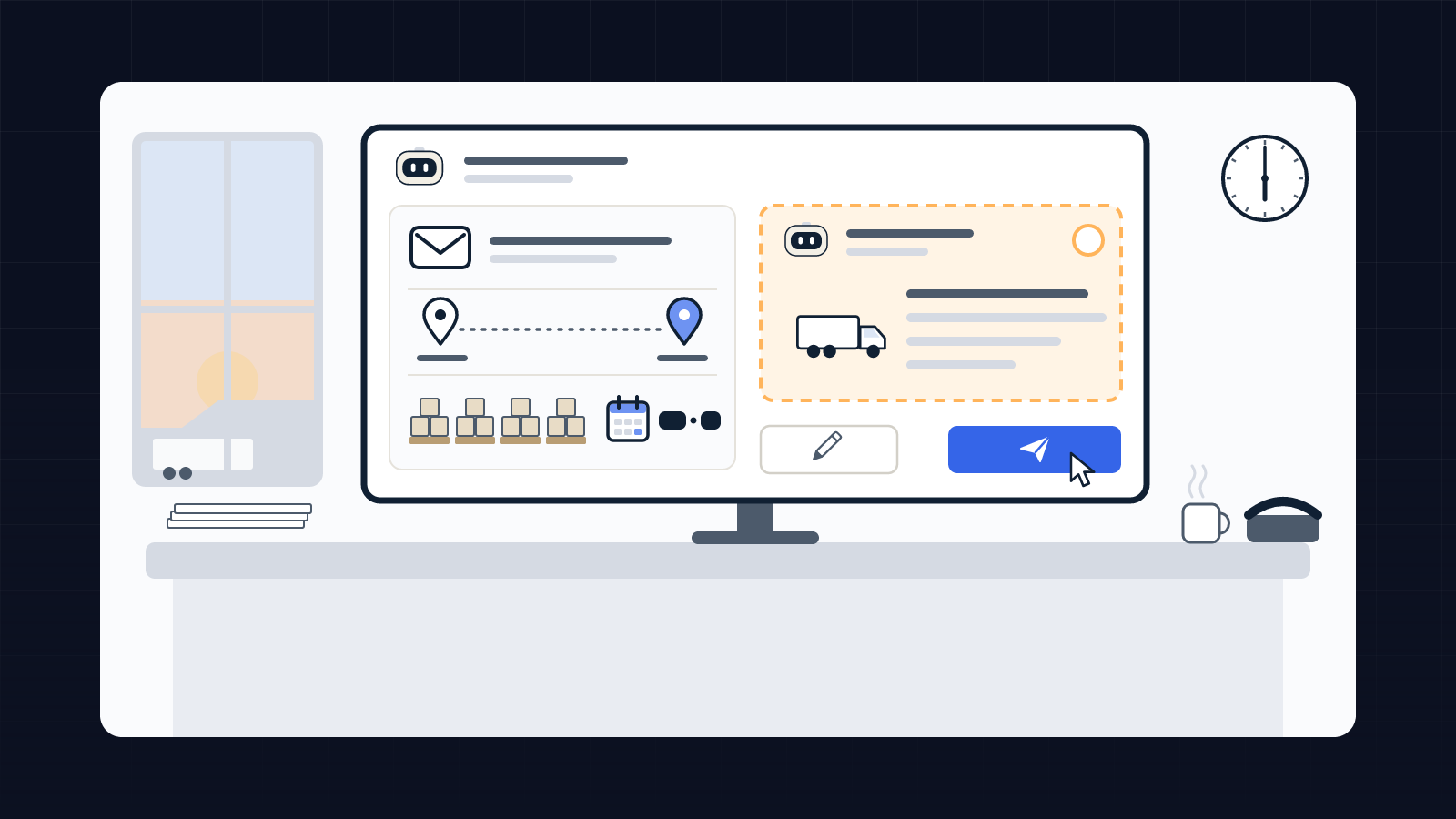
Early morning in a haulier's operations office: a screen shows a quote request received by email, summarised as origin, destination, pallets and date, with a drafted reply waiting to be checked

The same approach works for "where is my delivery?" questions, proofs of delivery to match against invoices, and reservations noted by consignees. The agent reads what your tools already hold (your transport management system, your warehouse software, your mailboxes) and prepares; someone on your team decides what goes out to the customer. It is the rule behind our quote request agent, applied to transport work.

Office taskWhat the agent preparesWhat stays with you
Quote requests received by emailShipment details extracted, rate card and surcharges applied, a drafted reply, a follow-up if the shipper goes quietThe final price, accepting the job
Customer tracking questionsStatus read from your transport software or subcontractor emails, a dated reply with the last known stepAnnouncing delays, commercial gestures
Reservations and damage on deliveryThe file: consignment note, photos, written reservations, protest deadline, a draft letterThe decision to claim, sending the registered letter
Invoices from subcontracted carriersMatching the invoice with the transport order and proof of delivery, with discrepancies listedApproval for payment, the discussion with the carrier

Why do most pages about AI for logistics talk about robotic warehouses?

Because they are written by the people who sell the equipment or the large software suites. On 15 November 2026 we reviewed the first nine organic Google results in France for "automatisation logistique" (logistics automation): six are about the physical warehouse (mobile robots, automated storage, intralogistics), and all three paid ads sell storage systems. For "ia logistique" (AI logistics), seven of the first nine results come from software vendors, a large consulting firm, public bodies or the industry association. For "ia logistique seine-et-marne", none presents a provider working with the department's small and mid-sized firms.

That content helps a site director planning a major investment. It does little for a company of 15 or 40 people whose bottleneck is a dispatcher answering forty emails before 9 a.m. Yet the interest is there: according to DataForSEO (data pulled on 15 November 2026), "ia logistique" and "automatisation logistique" each get around 90 searches a month in France, and "ia transport" around 140. The public framework too: on 24 March 2026 the French Directorate General for Enterprise and France Logistique published an AI adoption guide for the logistics and freight transport sector (in French), part of the "Osez l'IA" plan aimed at SMEs and mid-sized companies.

Why a page for Seine-et-Marne?

Because that is where logistics in the Paris region is concentrated. The Department describes itself as France's leading logistics department, with more than 6.5 million m² of warehouses built since 1975 (Seine-et-Marne Attractivité, page read on 15 November 2026, in French). According to the Seine-et-Marne Chamber of Commerce, the warehousing sector there had 293 establishments and 7,134 salaried jobs in 2020, or 30% of salaried warehousing jobs in Île-de-France (CCI Seine-et-Marne, December 2022 publication, in French).

Around the large hubs of Sénart, Marne-la-Vallée and the Roissy area you find regional hauliers, freight forwarders, hire-with-driver firms and mid-sized warehousing providers. Their operations office often runs with few people and a lot of paperwork. That office is who we work for.

The three-day deadline on damage claims: where the agent helps, and where it stops

For domestic transport in France, accepting delivery of the goods extinguishes any claim against the carrier for damage or partial loss unless the consignee notifies the carrier of a reasoned protest, by bailiff's notice or registered letter, within three days of receipt, public holidays excluded (Article L133-3 of the French Commercial Code, read on 15 November 2026, in French). A reservation written on the consignment note and then forgotten in a mailbox can cost you the claim.

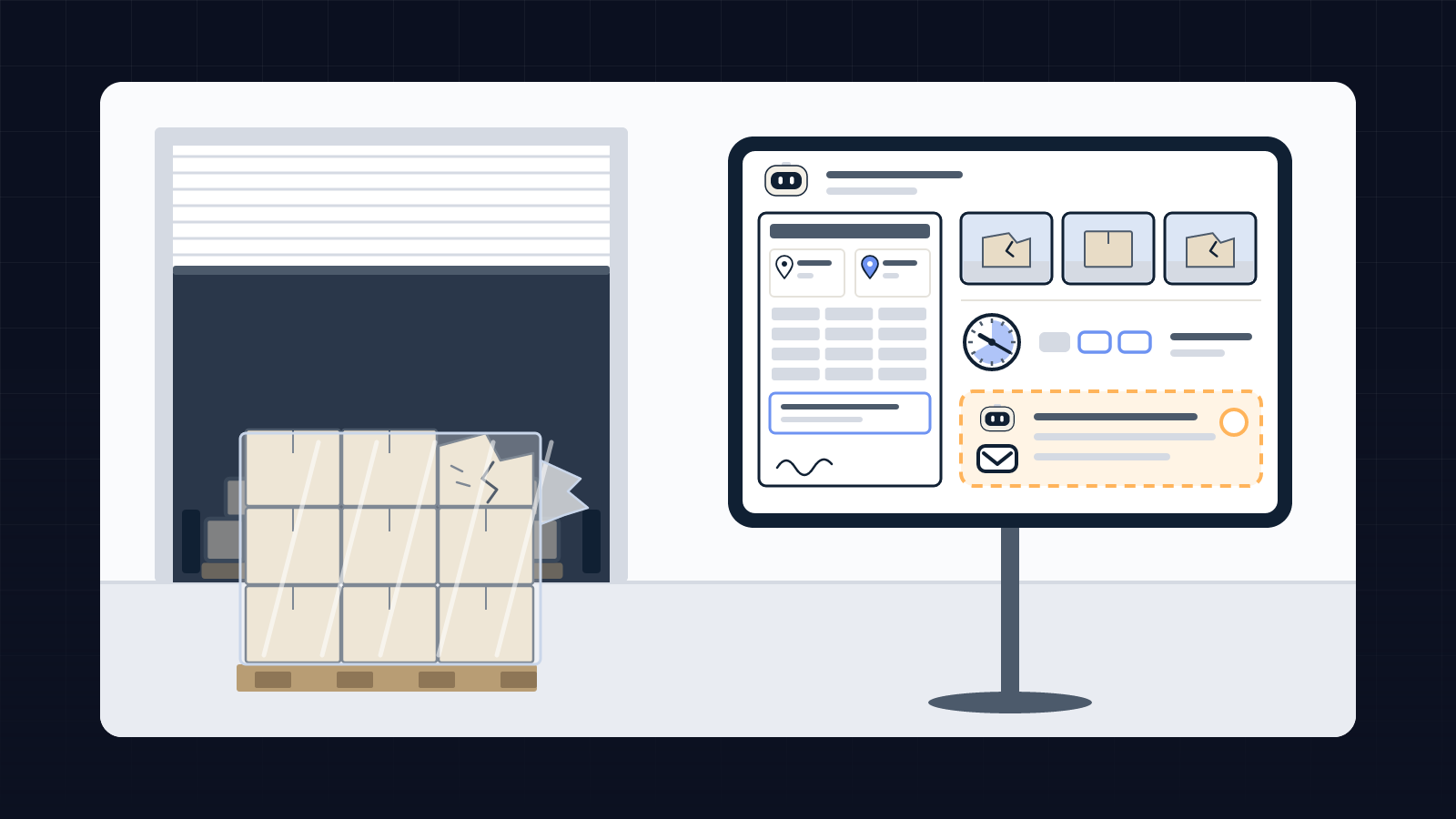
Loading dock in Seine-et-Marne: a damaged shrink-wrapped pallet next to a tablet showing the consignment note, the attached photos and the countdown to the protest deadline

The agent spots reservations in delivery returns, customer emails and incoming photos, works out the deadline, gathers the documents and drafts a letter. It alerts the person in charge before the deadline. It never sends the registered letter itself and does not decide whether to claim: that is a commercial and legal choice. International transport or specific contracts follow other rules; your adviser or insurer decides, not the agent.

What the agent does not do

It sets no price on its own, accepts no job, promises no delivery time and books no truck. It does not run the docks or the drivers, and it does not replace your transport software: it reads what is entered there. When it talks directly with a customer, for example through a form on your website, it introduces itself as an AI; the EU AI Act requires this for systems designed to interact with people. Our article on handling customer requests with an AI agent covers this in detail.

If your business looks more like selling goods than moving them, with orders and catalogue price requests, our page on AI for distributors will fit you better.

When is an agent not worth it?

When all requests come through a freight platform or exchange that already does the work, when you receive only a few quote requests a week, or when most things are settled by phone with the same customers. In those cases a rule in your current software, or nothing at all, beats an agent. The discovery audit is also there to tell you so.

How does it work in Seine-et-Marne?

It starts with a discovery audit on a single task, then a written scope before any paid work. Our head office is at 47 rue Vivienne in Paris; we come to your site in Seine-et-Marne at the quiet hours of your operations. We run our own agents on the agency's prospecting, content and admin, with the rule we apply for you: they prepare, a person approves what goes out.

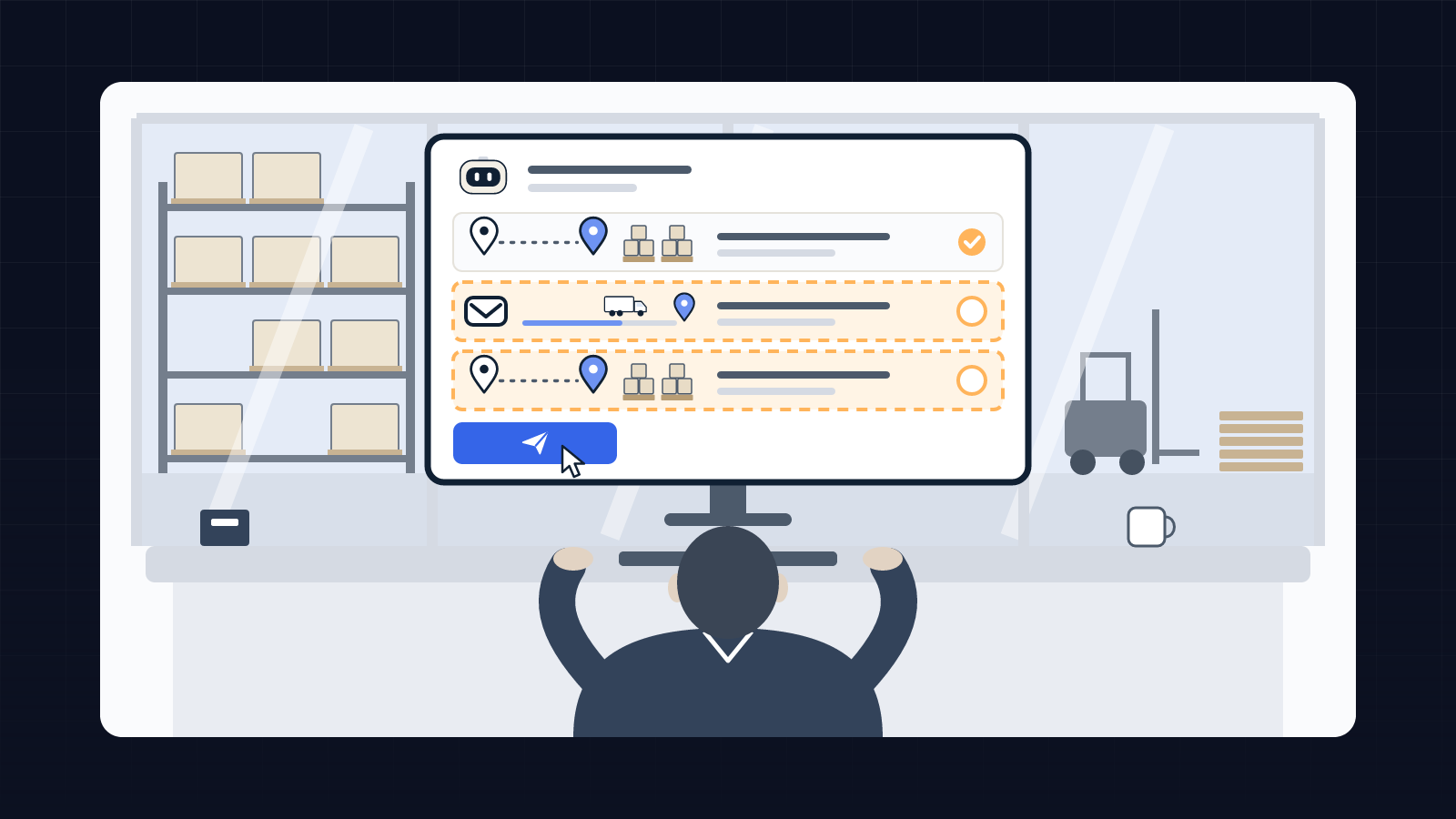
Operations manager in a glass-walled office overlooking a warehouse, reviewing on screen the quotes and tracking replies prepared by the agent before sending them to customers
  • The discovery audit (20 to 30 minutes, by video call or at your site): the chosen task, your transport or warehouse software, your mailboxes, what stays with the team. You leave with a written opinion: AI agent, fixed rule, or nothing worth building.
  • The written scope: what the agent prepares alone, what goes through the dispatcher, what it never does, and the quote.
  • The build: read-only first, on your past requests and files; you enter your own access credentials.
  • The trial run, two weeks: the agent prepares without sending anything, you compare with what the team did, then you decide whether to go live.

To pick the first task, read AI agents for small businesses: where to start. For our work in other departments, see our AI agency page for Île-de-France.

FAQ

Can an AI agent calculate my transport quotes?

It applies your rate card, minimums and surcharges to the details in the request, and flags what is missing to quote. The price sent is still decided by someone in operations, especially for an unusual route or customer.

Does the agent work with my transport or warehouse software?

It depends on what the software lets us read: an API, an export or notification emails. We have not checked vendor by vendor; we check with you during the audit. Without direct access, the agent works from the emails and exports you already receive.

Can it send the protest to the carrier on its own after damage?

No. It prepares the file and the draft letter, alerts you before the three-day deadline ends, and a person decides to send the registered letter. It gives no legal advice.

Do I need robots or an automated warehouse to use AI?

No. Our work is about the office: emails, transport documents, invoices. Warehouse equipment is a job for specialist integrators, and one does not rule out the other.

How long before I know whether it works?

The trial run lasts two weeks: the agent prepares without sending anything and you compare with the team's work. You judge on evidence before going live. We promise no result figures.