What can AI do for a small ecommerce business?
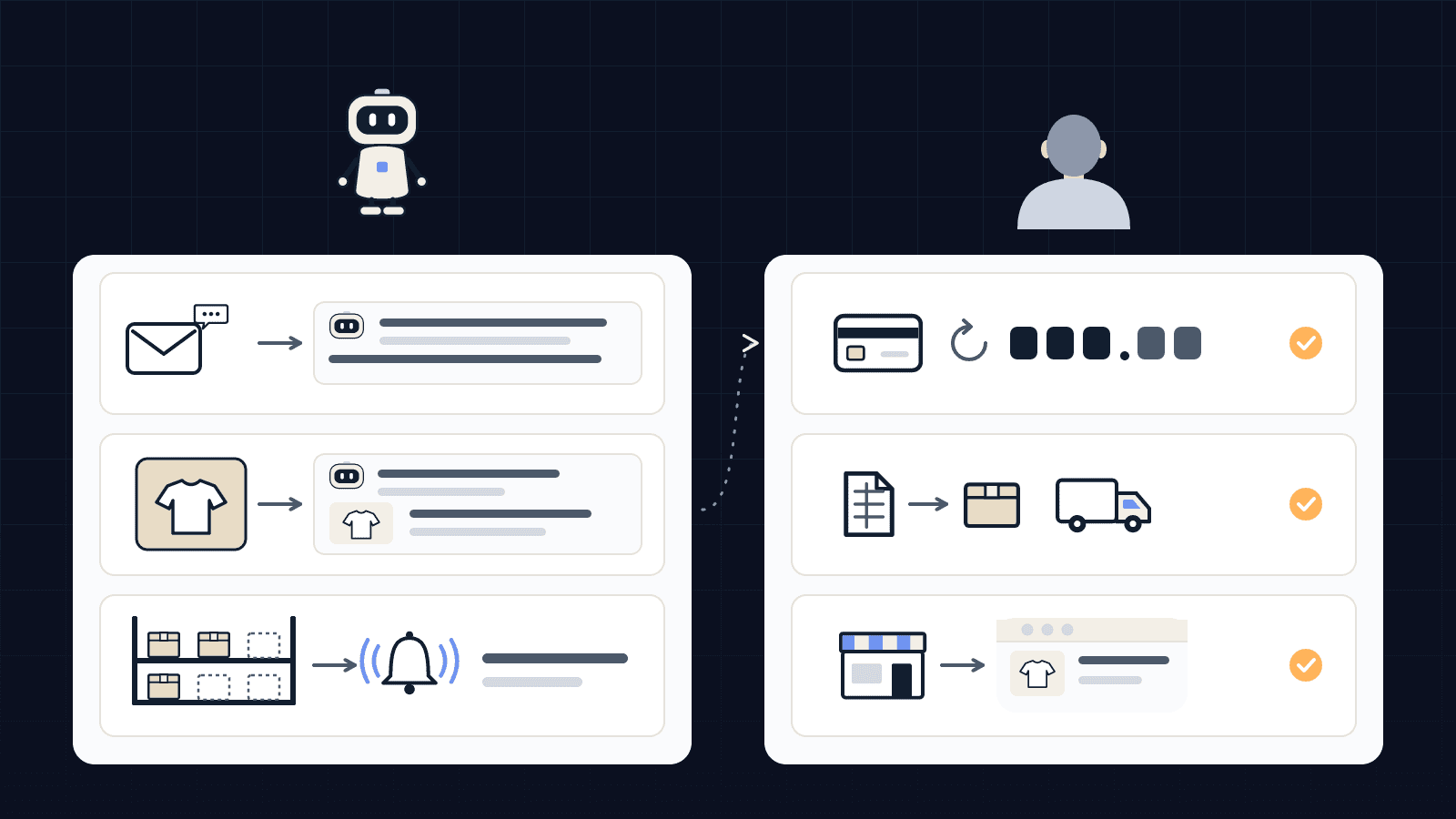
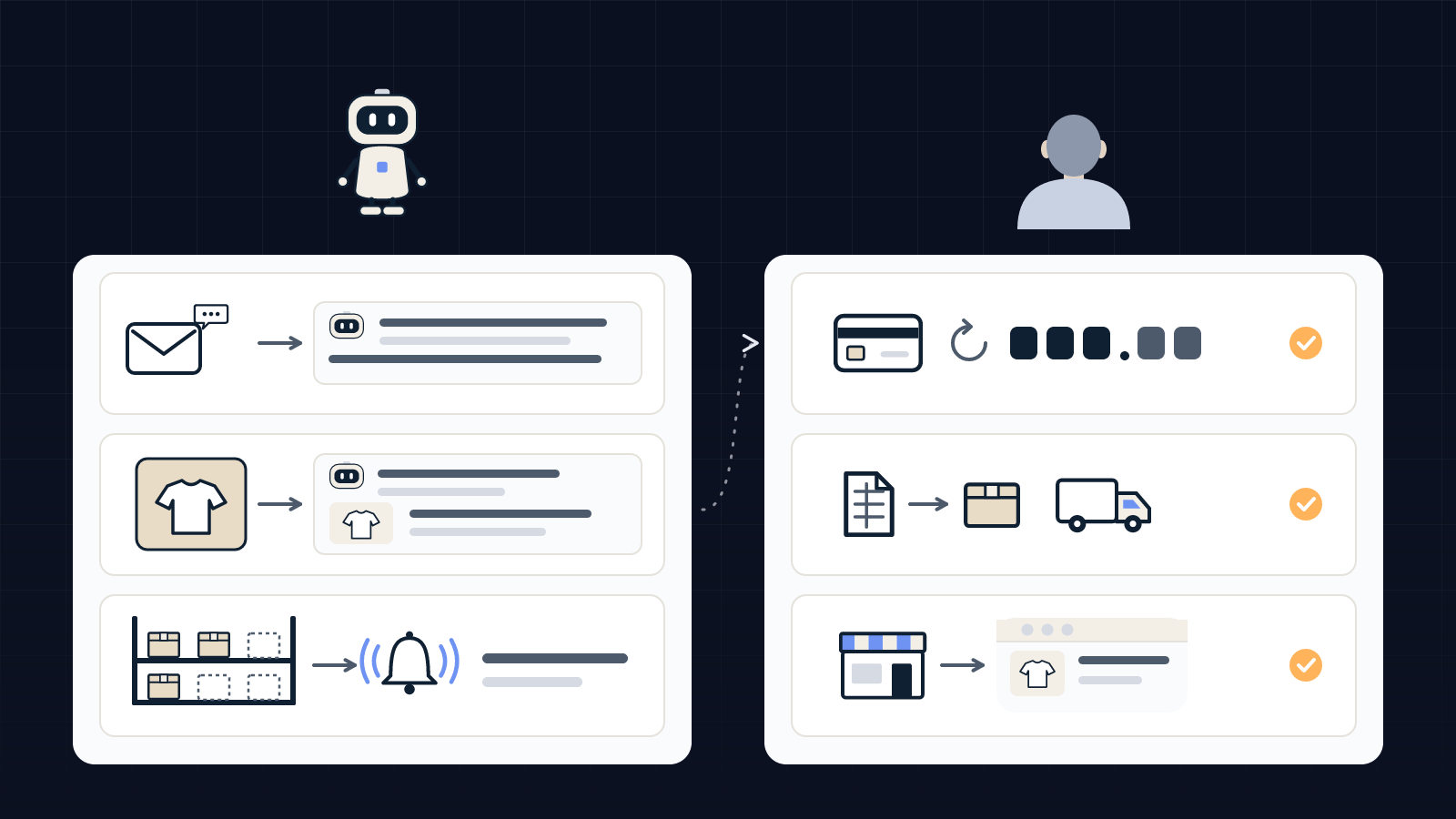
It takes over the preparation of repetitive tasks that require reading before acting. A customer writes "where is my order?": the agent finds the order, reads the carrier tracking and drafts the reply. A supplier sends a file of new products: the agent writes the product pages from the specifications, in your store's tone of voice. Stock on a best-selling item is falling faster than usual: the agent warns you before you run out and suggests a quantity to reorder.
In each case, the reading and writing are done, and the decision stays with you. That split is what makes the tool workable for a small team: nobody has to babysit software, yet nothing reaches a customer or a supplier without your approval. In France, the government's business directorate reports that 9 in 10 small retail businesses had not yet deployed any AI tool (DGE, February 2026).
Which tasks should you hand to an AI agent, and which should you keep?
The table below covers the six tasks we see again and again in online stores, with the agent's share and your team's share. The last column tells you when AI adds nothing over a fixed rule.
| Task | What the agent prepares | What stays with you | A simple rule is enough if… |
|---|---|---|---|
| Order questions | Finds the order, reads the tracking, drafts the reply | Disputes and goodwill gestures | Customers only ask for their tracking number: the automatic shipping email answers that |
| Product pages | Writes title, description and specifications from the supplier file | Review before going live | You add a handful of products a month |
| Stock and reordering | Compares recent sales with stock, warns before a stockout, suggests a quantity | The order to the supplier | Your sales are steady: a fixed alert threshold in your store software does the job |
| Customer reviews | Drafts a reply to each review, flags negative ones | Posting the reply | You get a few reviews a month |
| Returns and refunds | Checks the request against your returns policy, drafts the reply | Approving the refund | Your policy fits in one sentence and requests are rare |
| Competitor watch | Logs their new products and public price changes every week | What you do with it | You follow two or three competitors already |
The line follows one simple idea: the agent can read and write, but it does not spend money or speak for the store without approval. To set that scope tool by tool, our article on what access to give an AI agent and which approvals to keep walks through the method.
When is a simple rule enough?
When the task does not require reading or writing a different text each time. A low-stock threshold, the order confirmation email, the shipping label, switching an order to "shipped": your store software or a plugin already does this, predictably and with no AI usage cost.
An agent earns its place when it has to understand an open-ended message (a customer describing a problem in three sentences), write a tailored text (a product page, a review reply), or combine several sources (sales, stock, supplier lead time). If none of your tasks look like this, skip the agent and tune your store's built-in automations first.
What the top Google results say, and what they leave out
On 13 November 2026 we read the first 8 organic results Google showed in France for "IA e-commerce" (the French query for AI in ecommerce). They cover the possible uses well: personalised recommendations, chatbots, sales forecasting, content generation, fraud detection. Three points are missing almost everywhere.
| What we looked for on the page | Pages out of 8 |
|---|---|
| Speaks to small businesses (mentioned more than once) | 1 |
| Says what should stay approved by a person (the word "approve" or "approval" appears) | 1, only once |
| Is a page presenting the publisher's own offer | 3 |
Method: we read the full text of each page and searched it for these terms, using the organic results on the first page of Google France on 13 November 2026. The count does not rate the pages; it shows that the question a small store owner asks ("what do I let it do, and what do I keep?") barely gets an answer there.
Where should a small online store start?
With one task: the one that takes the most of your time each week and whose result you can measure.
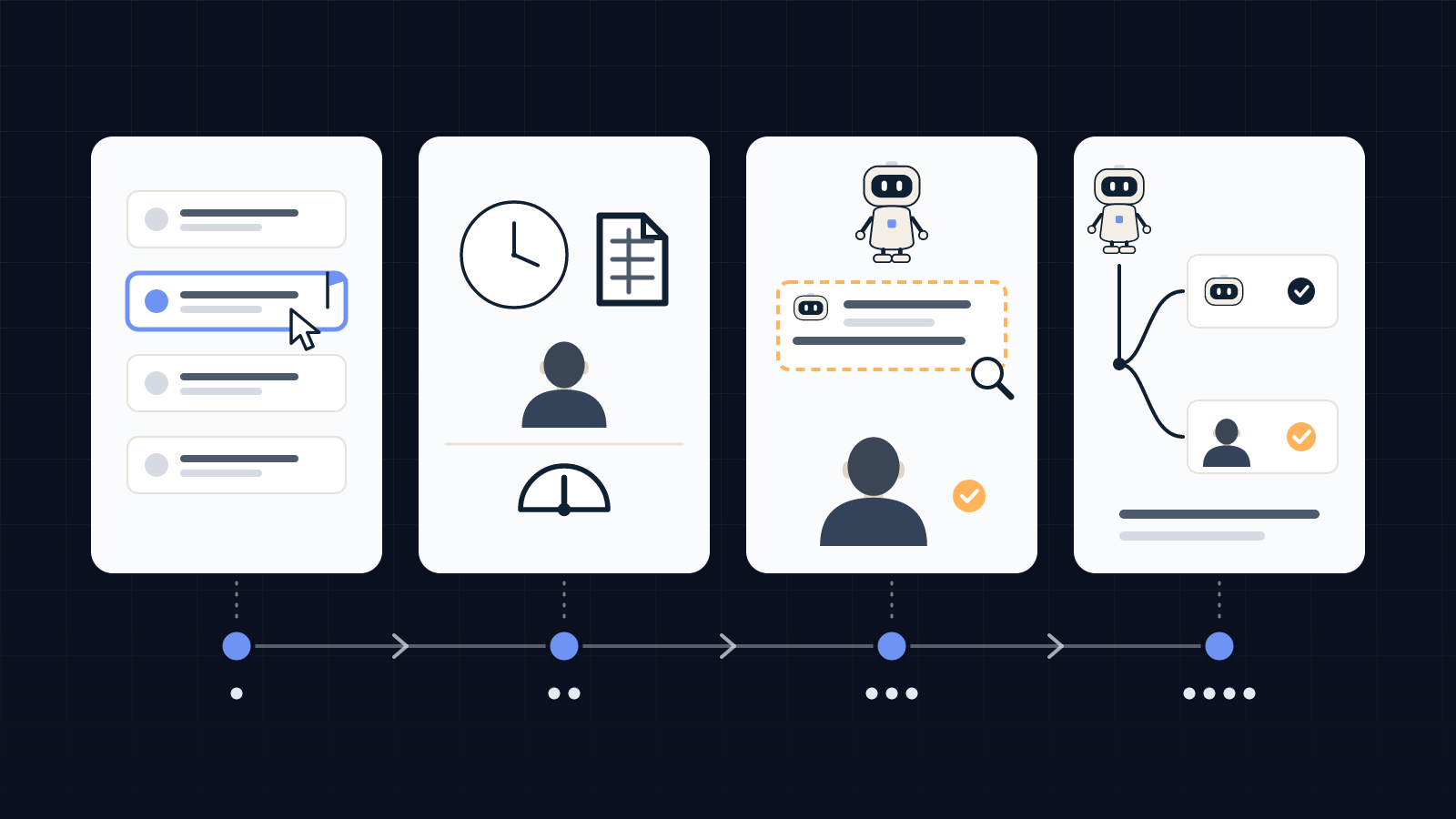
- Pick the task. For one week, note the time spent on each of the six tasks in the table. Keep the heaviest one.
- Measure before. How many messages, product pages or alerts per week, and how long each takes. Without this starting point, you cannot tell later whether the agent saves you anything.
- Let the agent prepare, and review everything. During the trial period, nothing goes out without you. You correct, and the agent follows your corrections and your written rules.
- Then decide what it does alone. A factual reply about parcel tracking can go out unreviewed if you decide so; a refund cannot.
This is how we work ourselves: at Équipage IA, the agents that handle our search visibility and social media prepare every piece of content, and every post waits for the founder's click. To see how a team of agents splits the work in a small business, read our page on AI agents for small businesses. If customer service is the task that weighs most, our article on AI agents for customer service goes further.
What data should the agent be able to read?
The data the task needs, and nothing more. For order questions: orders and parcel tracking, read-only. For stock: sales and quantities, read-only. For product pages: the catalogue and supplier files. Payment data does not need to be opened to it.
Your customers' details (name, address, purchase history) are personal data: an agent processing them must comply with data protection rules (GDPR in Europe), like any other tool. Keep a record of what the agent read, prepared and sent, and make sure you can revoke any access at any time. Your customers' own AI agents are also starting to contact stores: our article on agentic commerce explains how to handle them.
FAQ
Do I need to change my store software to use an AI agent?
In most cases, no. The agent connects to the tools you already use (store, inbox, stock spreadsheet), as long as they allow access. If a tool allows none, we tell you before starting.
Can an AI agent reply to customers on its own?
Technically yes, and we advise against it at first. During the trial period, it prepares and you send. You then decide, message type by message type, what can go out without review.
Can AI place reorders with suppliers?
It can suggest the quantity and prepare the purchase order. The order itself commits money: a person approves it.
How much time can I save?
Nobody can say before measuring it in your store, and we give no figure. That is why the "measure before" step comes before any setup.