What is the difference between an AI assistant and an AI agent?
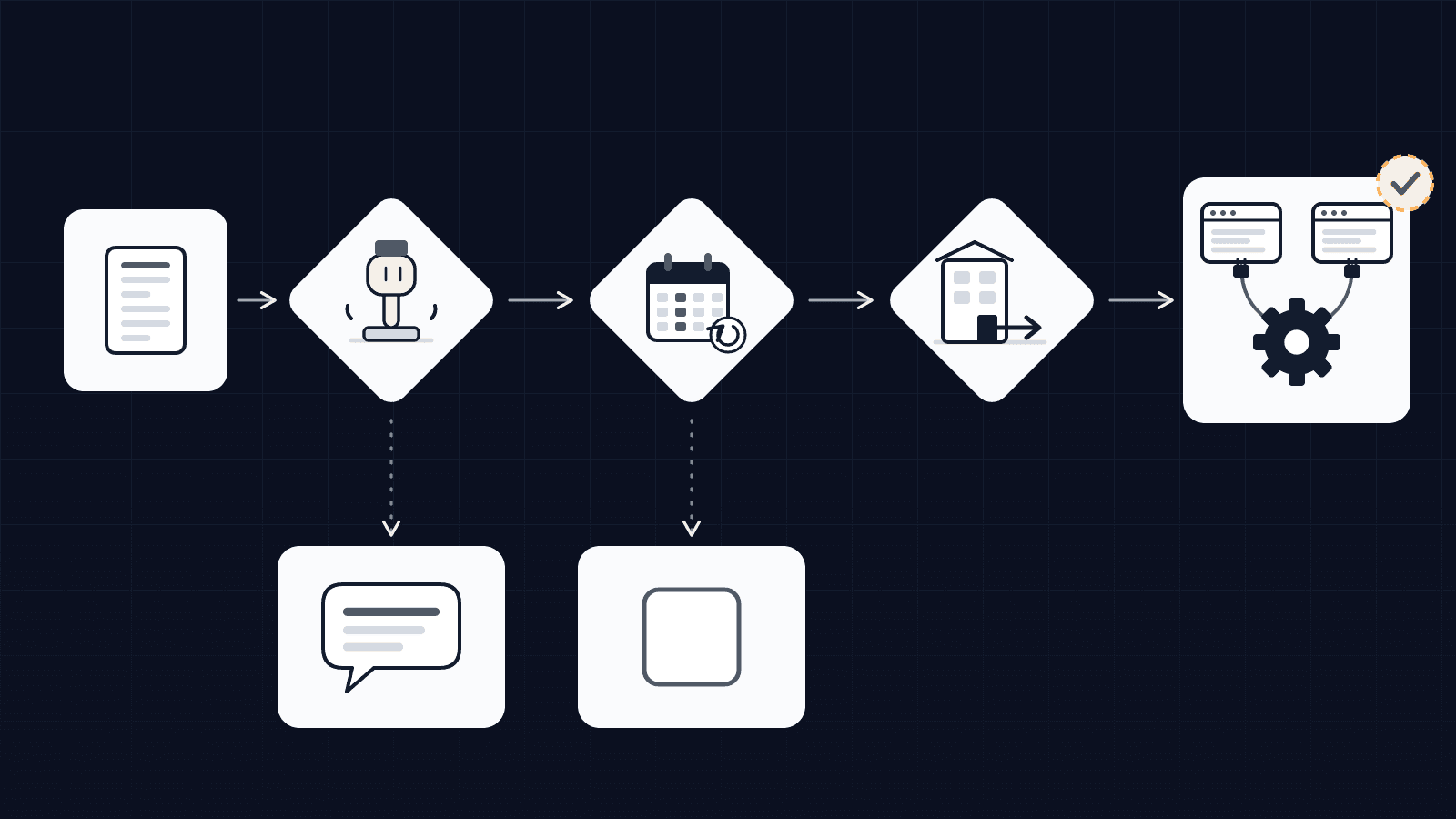
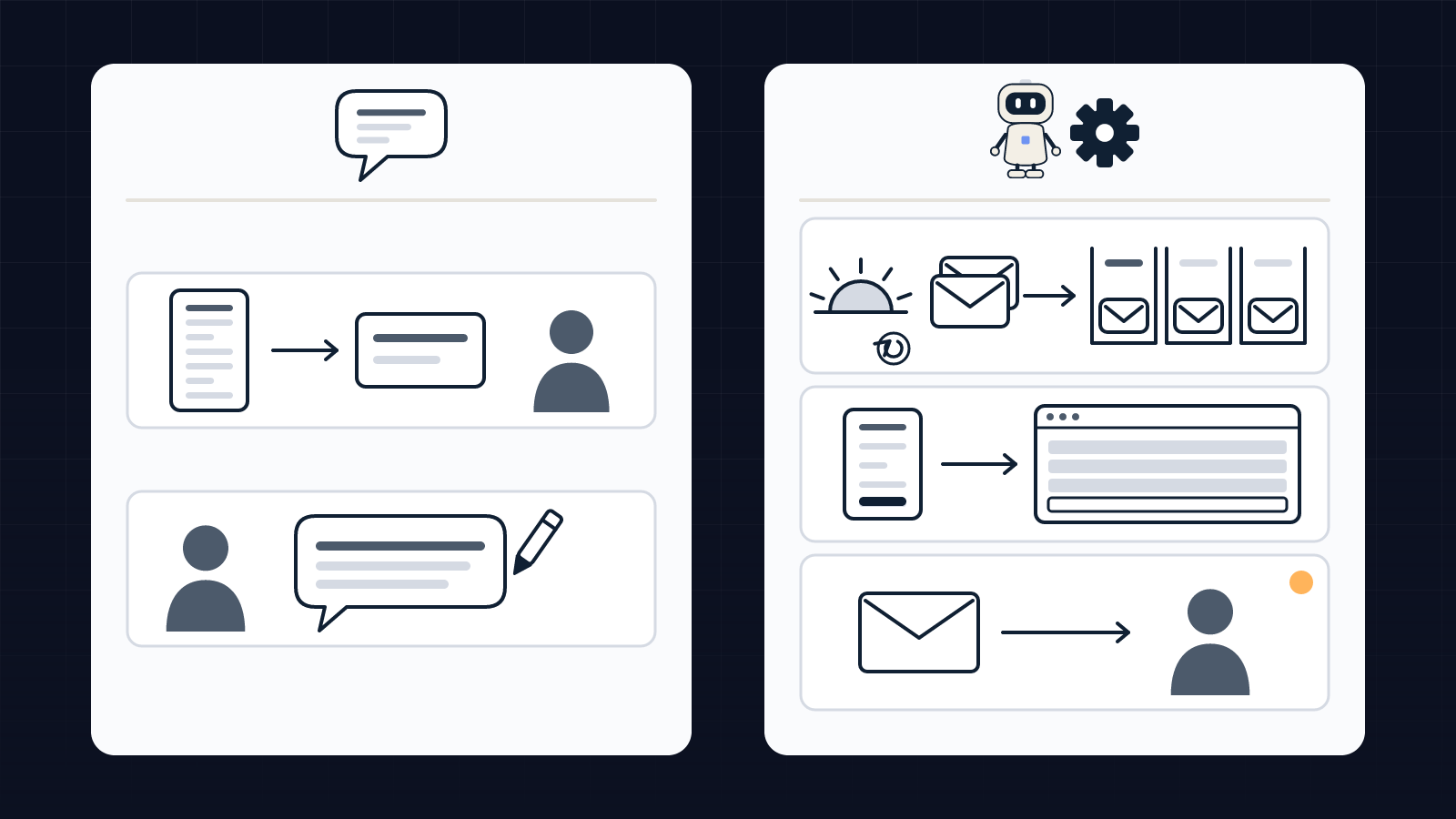
The difference is where the work stops. An AI assistant (ChatGPT, Copilot, Gemini or Le Chat in everyday use) answers a request: you ask, it produces a text, a summary or an analysis, and you decide what to do with it. Nothing changes in your software until you copy, paste or send it yourself. An AI agent receives a task rather than a question. It is connected to your tools, reads what comes in, prepares what is needed and can write in one specific place: a record in your CRM, a draft in your outbox, a line in your accounting software. The assistant waits for your request every time; the agent works on a stream of incoming work, following rules set once. Both run on the same language models. What separates them is the connection to your tools and the right to act.
Vendors do not even agree on the definitions. IBM describes assistants as reactive and agents as proactive. SAP describes the assistant as the layer that coordinates agents handling well-defined tasks. A French government guide for small firms calls the assistant a "digital copilot" that can call on agents to carry out tasks. So the label on a product tells you little: look at what it is allowed to do inside your tools. If your real question is about what answers customers on your website, that is a different comparison, the one between a business chatbot and an AI agent.
How do you know which one a given task needs?
Pick a precise task, not "accounting" or "sales": "follow up on quotes with no reply after ten days", "summarize a forty-page tender". Then ask it three questions, in this order.
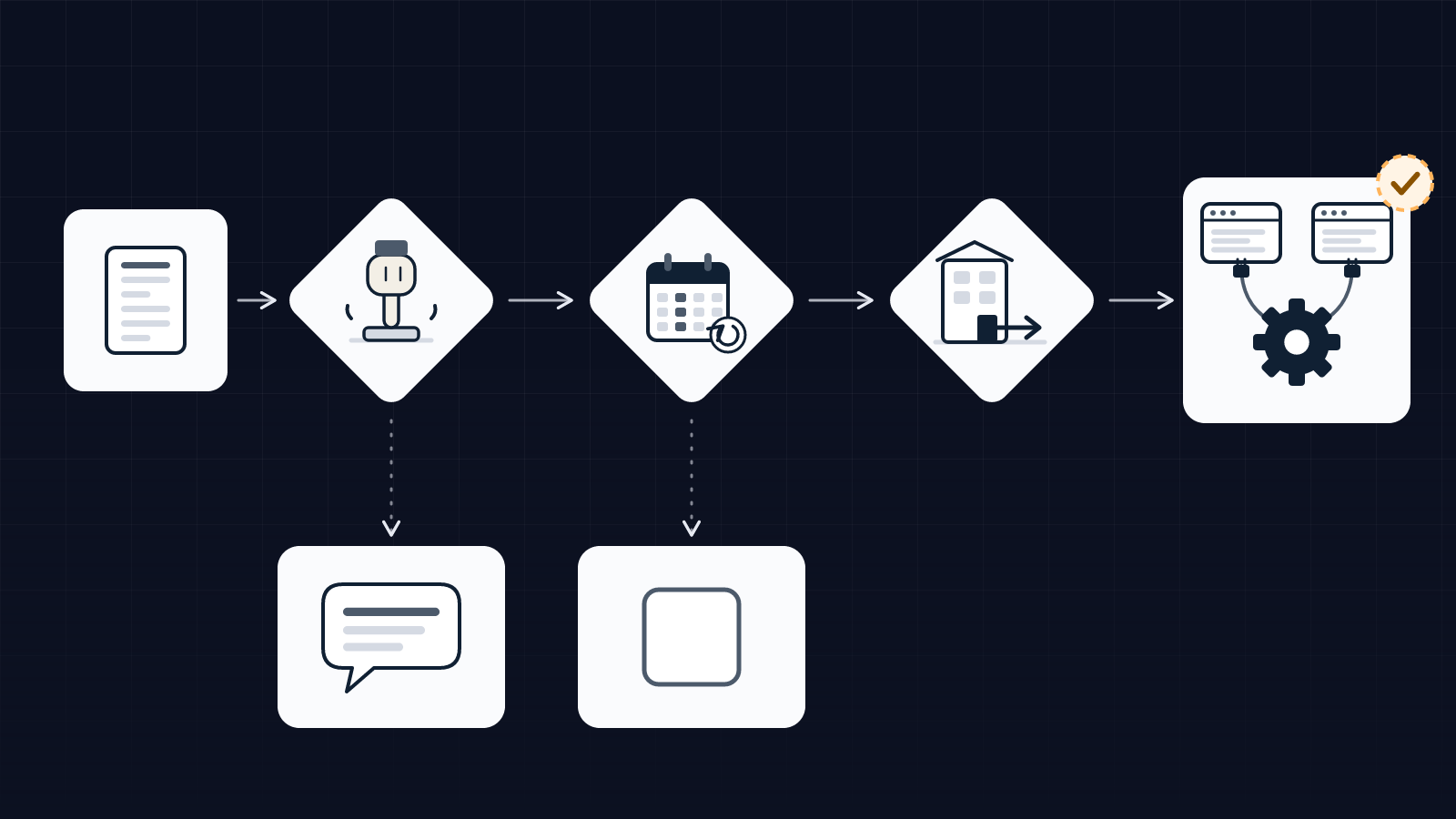
- Who makes the final move? If a person reads the result, fixes it and uses it themselves, an assistant is enough. If the result has to land in your software without anyone retyping it, you need an agent.
- Does the task come back every week, in the same shape? A rare or always-different task does not justify setting up an agent: you have to describe the work, connect the tools and test on real cases. A task that comes back twenty times a week with the same steps does.
- What leaves the company? Anything that goes to a customer, a supplier or a bank gets a human approval, whether the text came from an assistant or an agent. This question does not pick the tool; it sets the point where the agent stops.
Two "no" answers to the first two questions: an assistant, plus a written usage rule that says which data may be pasted into it. Two "yes" answers: an agent that prepares and a person who approves. And if the task only happens twice a year, there is nothing to build.
Which small business tasks belong to one or the other?
Applied to everyday tasks in a services or distribution business, the three questions give fairly clear answers. The table sums them up; check them against your own volumes.
| Task | What fits | Why | What stays with a person |
|---|---|---|---|
| Replying to an unhappy customer | Assistant | One-off case, tone matters | Sending it, and any commercial gesture |
| Summarizing a contract or a specification | Assistant | Occasional, a person reads the summary | Reading the clauses that bind you |
| Writing a job ad | Assistant | A few times a year | Choosing the candidate |
| Sorting incoming email every morning | Agent | Daily stream, filing in the inbox and the CRM | Replies that commit the company |
| Quote follow-up | Agent | Same steps for every quote, reads the CRM | Price, discount, the decision to send |
| Entering supplier invoices | Agent | Regular volume, writes to the accounting software | Payment, always |
| Preparing a client meeting | Assistant if rare, agent if weekly | Depends on volume | Running the meeting |
Our reference article explains what an AI agent really does in a business, and what it does not. If your team already uses custom GPTs, those are assistants: we described how to migrate them without breaking anything.
What does choosing wrong cost you?
The first mistake is giving an assistant a task that comes back every day. Someone opens the tool, pastes the email, copies the answer into the CRM, and starts again with the next email. The text gets written faster, but that person is still the link between every piece of software, and little time comes back. The France Num figures point the same way: 34% of French small and mid-sized firms use AI to generate content, 11% to automate tasks. AI came in through individual desks far more than through company processes.
The second mistake is building an agent for a rare task. You have to describe the work, connect the access, test on real cases, then review what it prepares during the first weeks. For a task that happens four times a year, that effort never pays back, and a well-used assistant does the job.
A third one has heavier consequences: giving an agent more rights than the task needs. An agent that sorts email does not need to be able to send any. We listed the questions to ask before connecting anything in our article on giving an AI agent access to your accounts.
How we split the work between our own agents
Équipage IA runs on its own agents, under written rules that we reread on October 16, 2026 for this article. Of the 9 agents on the team, 3 read, prepare and coordinate without writing to any outside tool: market watch, coordination and visuals. For the person who receives their work, they behave like assistants, and that person makes the move.
Each of the other 6 has one direct write permission, and only one: scheduling a post that has already been approved, keeping the CRM up to date, publishing the website after automated checks, adding prospects to a campaign that is already running within a daily cap, creating an invoice whose sending to the client is still approved by the founder, listing the agency in business directories with its published contact details. None of these permissions allows a payment. Launching a campaign, sending an invoice or publishing a post that has not been approved remains the founder's decision.
What we read before writing
On October 16, 2026, we looked at the top 10 results of a search engine for "assistant IA entreprise", the French query: three product pages, three tool rankings, four guides. We read four of them in full, plus two "AI assistant vs AI agent" comparisons published by IT service firms. The rankings name a tool without saying for which task. The comparisons draw their examples from IT systems monitoring, cybersecurity or coordinating several agents, and one of them plans human oversight of the agent "by exception". For a small business getting started, we recommend the opposite: approval first, then lighter checks task by task, once real cases show it is safe. In English, the top results for "ai agent vs ai assistant" on the same day came mostly from large software vendors.
FAQ
Is ChatGPT an assistant or an agent?
In a conversation, it is an assistant: it answers what you ask and you use the result. When an assistant gets connections to your apps and the right to write in them, it behaves like an agent. Ask the same access questions you would ask for an agent.
Can you start with an assistant and move to an agent later?
Yes, and it is often the right way to go. The assistant shows what the task really involves. Once it comes back every week and the answers look alike, you describe the steps and connect an agent to your tools, with its approvals.
Does a business with fewer than 10 people need an AI agent?
Not necessarily. What matters is the volume and the steps of the task, not headcount. A small business that receives many quote requests can get more out of an agent than a larger one that receives few.
Who answers for what an AI agent sends?
A message prepared by an agent goes out in the company's name, just like one from an employee. That is why what leaves the company gets approved until real cases have shown the task can do without it.
Sources: France Num, "Baromètre France Num 2026 : le numérique et l'intelligence artificielle dans les TPE et PME", published September 17, 2026, updated October 12, 2026 (francenum.gouv.fr, accessed October 16, 2026: 24% conversational assistants and chatbots, 34% content generation, 11% task automation). France Num, "AI assistant: a beginner's guide to automating tasks in a small business" (title translated, in French), published August 27, 2025, updated October 6, 2025 (francenum.gouv.fr, accessed October 16, 2026). IBM, "AI Agents vs. AI Assistants" (ibm.com, accessed October 16, 2026). SAP, "AI Agents vs. AI Assistants: What's the Difference?" (sap.com, accessed October 16, 2026). Équipage IA internal agent rules, reread October 16, 2026.